
Hello. This is Stanton Jones with what’s important in the IT and business services industry this week.
If someone forwarded you this briefing, consider subscribing here.
What You Need to Know
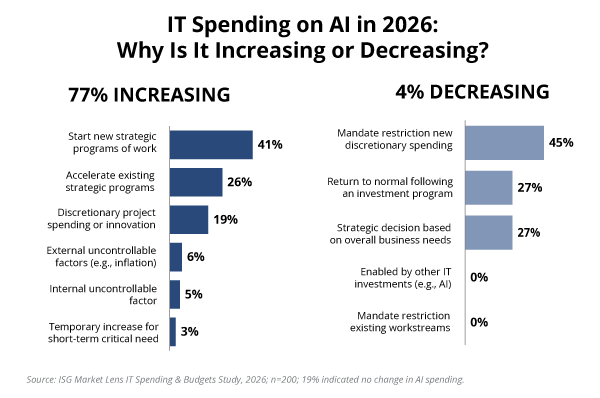
A majority of enterprises are increasing their spending on AI this year. Most of that spending is focused on starting net new projects rather than accelerating existing ones. But if companies don’t know how much all of this will cost, how do they know how much to budget?
Data Watch
Background
We’ve discussed at length over the past few quarters how strong enterprise spending is on AI. And the fact that, in many cases, AI spending is so strong that it is crowding out other parts of the IT budget. What we haven’t covered is whether 2026 AI budgets, many of which were set in late 2025, are realistic as projects move closer to production.
The Details
- 77% of enterprises are increasing their AI spending in 2026.
- Of those increasing AI spending, 60% are focused on starting new strategic programs or innovation this year.
- The average increase in AI spending compared to 2025 is 5.6%.
The AI Token Wall
So, if over 75% of companies are spending more on AI this year, and on average they are spending 5.6% more, is that “enough”?
No one really knows. Even though we’re over three years into this phase of AI, enterprises still struggle to estimate AI costs because production usage is variable, model behavior is probabilistic, and token pricing and pricing structures keep changing. My colleague Alex Bakker said it best a couple of weeks ago, “The only way to compare AI work to non-AI work is to profile the AI in production.”
This fact helps explain why many pilots are not moving to production. And why there is an increasing level of discussion (and concern) about the ROI of AI. It also explains why we’re seeing so many examples over the last quarter of strict mandates being put on AI spending. It’s just really hard to measure the benefits of AI given how differently this technology operates.
For IT services, that budgeting problem shows up differently in run work than it does in build work.
The “run” or “operate” portion is very clear: enterprises want committed, year-over-year savings that they can bank today. Note: this is where service providers are taking on much of the risk today, but also why a new pricing model like autonomy-level pricing is needed to de-risk the environment for both providers and enterprises.
But if we look at the “build” part of the sector, the story is different. What if we look at models as tools to dramatically accelerate technical modernization? More specifically, what if we use tokens to build non-tokenized systems? For example, how many mainframe applications need the probabilistic logic of an OpenAI or Anthropic API call versus a deterministic API call?
That could open up a very long tail of opportunity for providers and help enterprises start to pay down the mountain of technical debt many of them are under today. The uncertainty here would be in the estimation of the project work, not in the ongoing run work. Which maps pretty closely to how companies are already set up to run today.
About the author

Stanton Jones
Stanton helps enterprise technology leaders, IT service providers and buy- and sell-side professionals make sense of the global IT services sector. Stanton's weekly briefing - the Index Insider - is read by thousands of industry stakeholders each week.
