
Forget AI drift. The more immediate risk facing enterprises is strategic drift. This is when organizations start chasing the AI narrative faster than their own mission.
Planning for a strategic future, an eco-friendly sneaker company would have considered it only hypothetical whether it should become an AI infrastructure provider or not. Yet Allbirds, born out of a former New Zealander footballer’s dream to create sustainable footwear, has pivoted into an AI infrastructure provider and relabeled itself as NewBird AI. It would be naive to dismiss this as a anomalous market anecdote. It heeds a warning. When companies start chasing a generic AI narrative faster than they can explain their value to humans, they are no longer transforming. They are in the process of drifting away from their core business capabilities.
The dynamic is not novel in the age of AI. During the blockchain boom, there were various organizations that tried to capitalize on this wave, including Long Island Iced Tea, which transitioned into Long Blockchain. The U.S. Securities and Exchange Commission later noted that the company’s stock spiked more than 380% intraday after the blockchain pivot announcement. Long Island Iced Tea was not alone. Many other companies simply changed their name, and markets rewarded the signal handsomely. With AI, this behavior is simply window dressing.
This is not an example of model or AI drift. It is strategic drift.
Strategic drift begins when AI becomes an enterprise’s North Star rather than a tool for its benefit. It begins when organizations prioritize being AI-led instead of using AI in practical ways to become more valuable to customers, employees and society. It begins when AI becomes a story before it becomes a disciplined value proposition.
This distinction matters. FactSet found that the term “AI” was cited on 331 S&P 500 earnings calls for Q4 2025 alone, representing 68% of all calls it reviewed during the period. Historically, this is the highest number in the past 10 years for current index constituents. AI has become important boardroom language, an investor signal, a sourcing requirement and, increasingly, an employment rationale.
But AI adoption is not the same as strategic progress. A company can automate faster and still lose trust with customers. It can reduce effort and still weaken the services it offers. It can remove roles and still damage future capability. It can own the model, the data architecture and the cloud stack, while outsourcing the one thing that matters most: decision and judgment.
What does it mean to offer value to humans? It means all people involved along the value chain – employees, customers and the broader ecosystem of suppliers and partners – benefit fairly from such an investment.
To offer value to humans, an enterprise must build trust, robust judgment, fair relationships, creativity, learning pathways and accountable decisions that make an organization useful beyond its technology stack. It is what customers experience when service improves, not merely when response times fall. It is what employees experience when AI expands capability, not merely when it removes tasks. It is what leaders preserve when they ask not only, “What can we automate?” but also, “What must remain meaningfully human?”
Don’t Let Trust Be the First Casualty
Markets have always been captivated by technology fads. What feels different now is the speed with which AI narratives can affect corporate language, investor expectations, workforce decisions and sourcing strategies. The risk is not that organizations have dialogue about AI. In fact, that should be encouraged. The risk is that the language of AI becomes more advanced than the value case behind it.
Customers, employees and investors are becoming more discerning. Edelman’s 2026 Trust Barometer Special Report argues that, in an insular world, brands cannot simply declare relevance and trustworthiness; they must prove it through experience. That is a critical point for AI because customers, employees and stakeholders are no longer impressed by the presence of technology alone. They expect usefulness, credibility and alignment with what they value.
That matters deeply for AI. Customers are not asking whether a company has deployed AI. They are asking whether the experience became easier, safer, more personal, more trustworthy or more useful. Employees are not asking whether AI increases productivity in a spreadsheet. They are asking whether the organization still sees their capability as an asset. Investors are not only asking whether AI appears in the strategy. Increasingly, they will ask whether AI creates measurable advantage.
This is also visible in enterprise sourcing. ISG’s 2026 Market Lens BPO Study points to an uncomfortable gap: productivity and efficiency are regularly measured and overperforming while delivery of AI-led innovation remains undermeasured and underperforming.
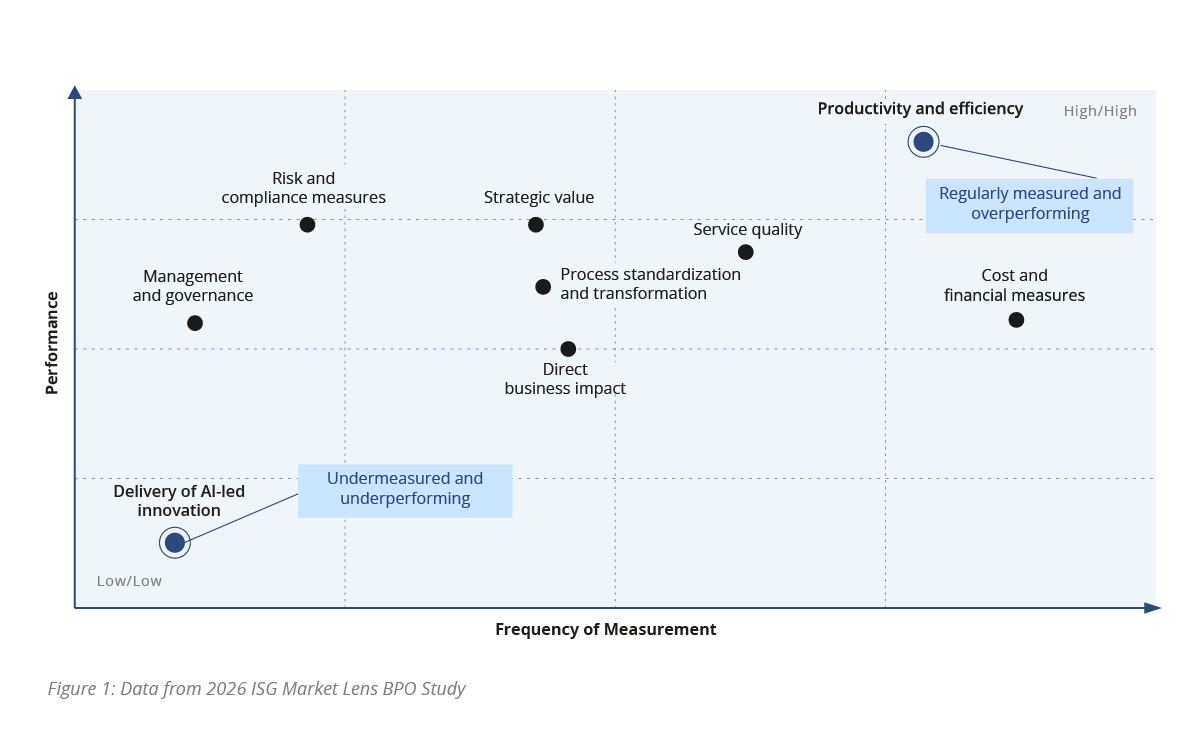
For sourcing leaders, CIOs and CHROs, this is a practical warning. If AI is measured only as efficiency, it will be managed only for efficiency. If contracts, transformation programs and operating models reward cost extraction but not service quality, trust, resilience or innovation, then AI will follow the measurement system. It will optimize what leaders ask it to optimize.
That is where strategic drift begins. Organizations mistake adoption for progress. They automate processes without improving experiences. They reduce effort without increasing trust. They pursue efficiency without asking what new value they are creating.
AI transformation cannot be justified by novelty alone. It must be anchored in principles including what the organization exists to deliver, who it serves and how technology strengthens the value it provides to people all along the value chain – employees, customers and suppliers.
Please fill out this form to continue.
The Talent Pipeline Is Being Hollowed Out
The gap in value we see inside enterprises is now appearing in the systems that prepare the next generation of talent.
Stanford’s 2026 AI Index reports that while a majority of U.S. high school and college students use AI for schoolwork, only half of middle and high schools have AI policies and just six percent of teachers say those policies are clear. Students are already using AI for research, essay editing and brainstorming, but many institutions are still struggling to provide consistent guidance, assurance and guardrails.

Imagine asking students to participate in a physical education class without proper equipment, under the supervision of someone who understands the importance of exercise but not the risks of injury. Or imagine a science lab where students are given chemicals and a Bunsen burner, but no clear explanation of acids and alkalis, nor the right safety procedures or how to extinguish a flame.
That is effectively what we are doing with AI. We are putting powerful tools in the hands of the next generation without consistent instruction, safeguards or accountability.
Enterprise leaders should care because this is not just an education problem. These students are the next analysts, developers, consultants, product owners, sourcing managers, service agents, finance leaders and client-facing executives. If they learn to use AI without learning judgment, evidence, accountability and context, the future workforce will not be more capable. It will be more tool-dependent.
The pressure is already visible in early-career work. The World Economic Forum reports that more than one in three young workers globally are employed in occupations with medium to high exposure to AI-driven task change.
This matters because early-career work has always been more than a cost category. It is how people learn judgment, context, resilience, client service, problem-solving and professional confidence. Much of what junior employees do may be slower, more manual or easier for senior colleagues to complete. But that is precisely the point. Entry-level work is a rite of passage. It is how capability is built.
If enterprises automate away entry-level work without replacing the learning path, they are cutting off the first rungs of their own talent ladder.
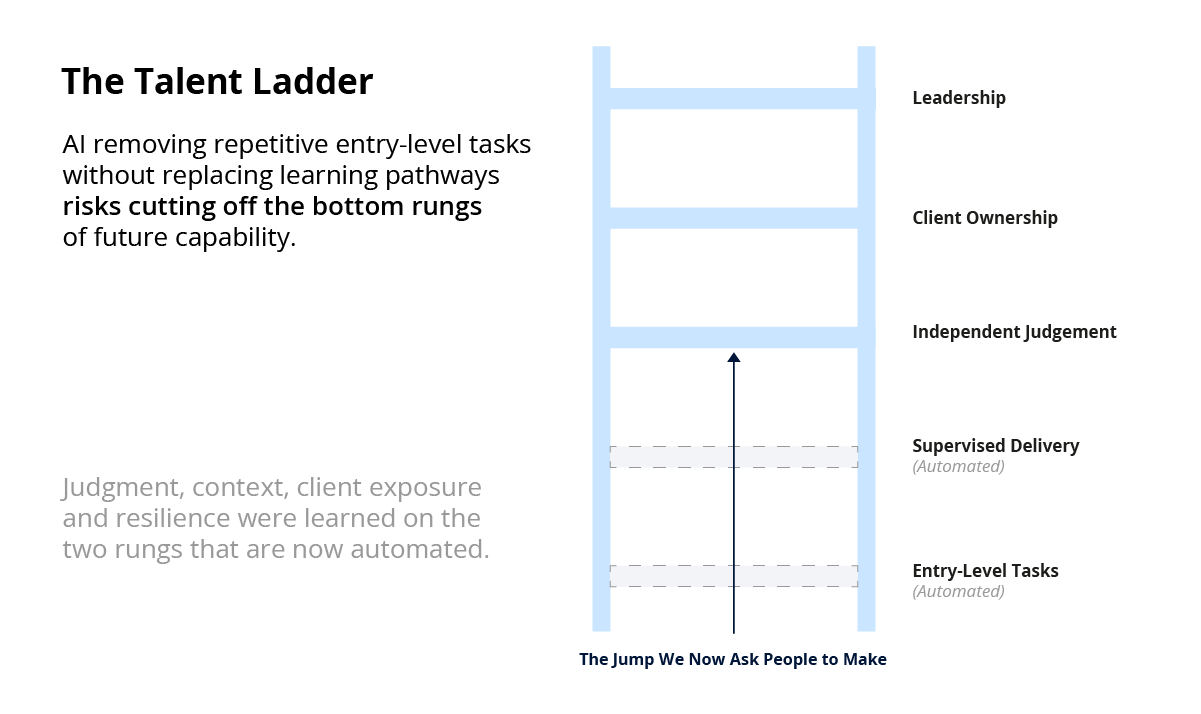
That raises an uncomfortable question: how can a company credibly call itself a “great place to work” or an “employer of choice” while removing the very pathways through which future employees learn, grow and contribute?
For this reason, enterprises must rethink their AI strategies and return to the value they can offer humans. In other words, they need to consider how all people involved along the value chain – employees, customers and the broader ecosystem of suppliers and partners – can benefit fairly from such an investment.
Enterprises must be careful to keep AI from becoming a mechanism that hollows out capability. It should be used to expand it.
4 Reasons Enterprises Must Return to Human Value
The following are the reasons enterprises need to re-prioritize how they provide value to humans.
1. Workforce displacement is becoming a test of corporate character.
There is a difference between redesigning work and hiding behind automation.
The responsible enterprise does not begin with the assumption that human labor is a cost to be removed. It begins with the assumption that human capability is an asset to be redirected. AI may reduce the need for repetitive tasks, but it can also increase the need for judgment, empathy, design, governance, domain expertise, relationship management and complex problem-solving.
IKEA provides a useful example. Ingka Group, the largest IKEA retailer, reported that its AI-powered chatbot Billie resolved approximately 47% of customer inquiries from 2021 to 2023. The 8,500 call-center workers were not replaced but were reskilled in areas such as remote interior design, digital retail sales, relationship-building and complex customer problem-solving. This is the right lesson: AI can take on repetitive volume while people move closer to differentiated value.
While this may seem like the most suitable and best solution, not every organization has embraced IKEA’s model. Financial technology company Klarna, once widely cited for aggressive AI-led customer-service automation, later shifted its messaging toward reinvesting in human support. Customer Experience Dive reported that Klarna continued to use AI heavily, but also acknowledged the need to invest in empathy, expertise and real human conversations, especially where quality and customer trust are at stake.
That is the strategic distinction. AI can mimic efficiency in routine interactions. It cannot replace human trust in complex, sensitive or high-stakes moments.
If AI is used only to remove roles, the organization may achieve short-term savings but lose institutional knowledge, trust and resilience. If AI is used to elevate people into higher-value work, the organization builds capability. This is where human value becomes strategic value.
2. Regulation is becoming a mirror of cultural priorities.
AI regulation is often treated as a compliance matter, but enterprises must treat it more seriously than that. Regulations show what societies choose to protect, what they penalize and what they consider valuable enough to warrant policy.
Europe’s approach reflects concerns for fundamental rights, safety, transparency and risk-based governance. At the same time, the Council of the EU has moved to simplify and streamline certain AI rules, including delayed application dates for some high-risk AI obligations. December 2027 is a deadline for stand-alone high-risk systems and August 2028 is a deadline for high-risk systems embedded in products. This delay reflects a tension felt by founders and entrepreneurs in Europe, the need to protect rights and safety, while avoiding rules that are seen as slowing innovation or weakening competitiveness.
China is sending a different signal. Chinese courts have ruled in cases involving AI-related layoffs and pay cuts that replacing workers with AI does not automatically justify termination or adverse employment action. In one reported case, courts found a dismissal illegal after an employee refused a demotion and salary cut linked to technological upgrades and AI replacement. In another, a court held that using AI was a business decision and did not qualify as a major change in objective circumstances that would allow termination.
For global enterprises, this creates complexity. If a market protects employment stability, AI workforce transformation must be handled differently. If a market prioritizes explainability and fundamental rights, AI decision-making must be designed accordingly. If a market prioritizes technological sovereignty, organizations must examine infrastructure, data residency and provider dependency. If a market prioritizes innovation speed, leaders must still decide which guardrails they will voluntarily uphold.
The danger is assuming that minimum compliance equals responsible action.
A multinational enterprise should not only ask, “What is legally permissible in this market?” It should ask, “What do we believe is worth protecting?”
That question must apply to data, models, infrastructure, intellectual property, customer trust and employment. It must apply to the way AI influences decisions about people. It must apply to whether humans can understand, challenge and override consequential AI-supported outcomes.
Regulation may differ by country. Enterprise values should not.
3. AI euphoria can create strategic imitation.
When markets reward AI announcements, organizations can become more focused on appearing AI-driven than on becoming value-driven. The result is a form of strategic imitation: similar copilots, similar productivity claims, similar automation roadmaps, similar investor language and similar operating-model promises.
But competitive advantage rarely comes from copying the toolset. It comes from applying technology to a differentiated understanding of customers, operations, talent and market position.
This is where enterprises need to be honest. Not every AI use case is strategic. Some are hygiene. Some are productivity improvements. Some are experiments. Some are distractions. Some are, dare we say it, vaporware.
A mature AI portfolio distinguishes between:
- AI that improves productivity
- AI that reduces risk
- AI that improves customer experience
- AI that creates new revenue
- AI that strengthens resilience
- AI that builds strategic differentiation
- AI that merely follows the market narrative
The last category is the most dangerous because it consumes attention without creating advantage.
For CIOs, this means resisting the temptation to present every AI use case as transformation. For sourcing leaders, it means separating provider theater from measurable outcome commitments. For CHROs, it means asking whether AI changes work in ways that strengthen capability or simply remove capacity. For CEOs and CFOs, it means asking whether an AI investment is building a better business or merely a better story.
AI should not be adopted because it is fashionable. It should be adopted because it is the right capability to deliver a clearly defined human, commercial or societal outcome.
In every gold rush, Blockchain rush and AI rush, some companies mine real value while others only repaint the signage of their store. Senior leaders need to know which one they are doing.
4. Human value is the new sovereignty question.
AI sovereignty is often discussed through the lens of data, infrastructure, models, cloud dependency and legal jurisdiction. These remain essential. Organizations need to know where their data resides, who controls their models, which providers they depend on, whether their systems are explainable and whether critical AI services can continue if a provider fails.
But there is another sovereignty issue enterprises can no longer avoid: human sovereignty.
Who controls the future of work inside the organization? Who decides how human capability is valued? Who benefits from the productivity gains AI creates? Who is protected when work is redesigned? Who is accountable when AI makes or influences decisions about people?
An enterprise that loses control of its workforce strategy has not achieved AI sovereignty. It has simply shifted dependency from technology providers to market pressure. It is possible to own your data architecture while outsourcing your judgment. It is possible to govern your models while failing to govern the consequences of deployment on humans
That is not sovereignty. It is strategic drift with better tooling.
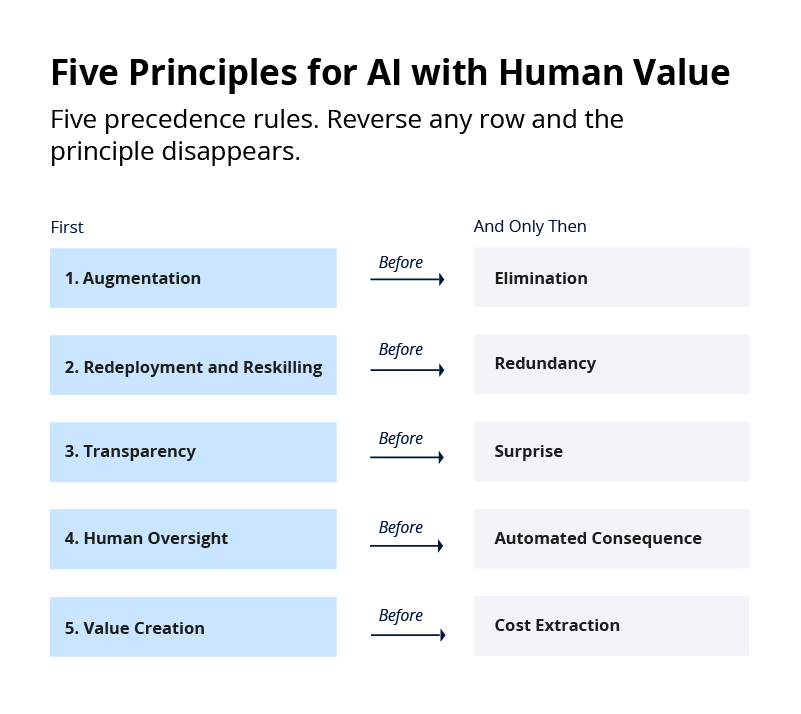
Providing real value to humans must therefore become a core component of AI strategy. That means designing AI adoption around five principles:
- Augmentation before elimination. The first question should be how AI amplifies people, not how quickly it removes them.
- Redeployment and reskilling before redundancy. Where tasks are automated, organizations should assess whether employees can move into higher-value work.
- Transparency before surprise. Employees should understand how AI will affect roles, decisions, expectations and opportunities.
- Human oversight before automated consequence. AI systems that influence employment, customer rights, safety, finance or access to services must remain explainable, contestable and accountable.
- Value creation before cost extraction. AI should be measured not only by savings but by the new human and customer value it enables.
From AI Adoption to Intelligent Authenticity
Enterprises should not allow themselves to be led by the next wave of euphoria of AI. They should return to their core business principles of operation and ask:
- What do we exist to deliver?
- Which human needs do we serve?
- What knowledge, judgment and relationships make us distinctive?
- Where can AI enhance those capabilities?
- Where must humans remain accountable?
- How do we share the gains of productivity with employees, customers and society?
The companies that win with AI will not be those that drift fastest. They will be those anchored on the clarity and quality of the value they exist to create for humans.
That is the difference between AI adoption and intelligent authenticity.
The future of AI will not be defined by how much work organizations can automate. It will be defined by whether they can still explain and prove to humans the value they are here to create.
About the author

Dr. Dorotea Baljević
Dorotea Baljević is a Director within the AI Acceleration Unit, enabling clients in their business, AI and data transformations while delivering value across the entire ecosystem.
Dorotea provides support and counsel to customers in their current and future digital journeys. Particularly focusing on improving and enhancing data and AI capabilities for the decision-making ecosystem to ensure healthy organisational longevity and relevance. This includes a focus on value driven outcomes, responsible use of data and AI, and shaping authentic and right-size solutions that align to the clients current and strategic needs.
Her spectrum of experience includes innovation, green-field environments, existing transformations (including building high performing teams), governance, regulatory preparation and compliance, development of digital threads and decommissioning.
