
This is Alex Bakker standing in for Stanton Jones with what’s important in the IT and business services industry this week.
If someone forwarded you this briefing, consider subscribing here.
SAP Migration
Since SAP’s announcement last year that it would be phasing out support for its ECC ERP systems, organizations have been accelerating their transition to S/4 HANA. Spending – in terms of time, effort and budget – has been up.
In November, ISG Market Lens looked at how organizations are progressing in their migrations. We found that, for a large swath of organizations on this migration, the software itself is far less consequential than the organizational change it implies. (See Data Watch)
Data Watch
Overview
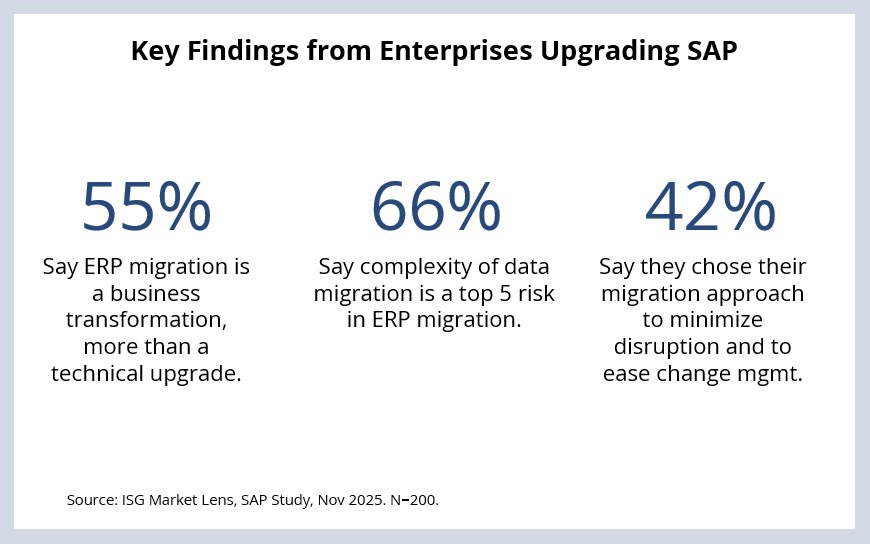
Just over half (55%) of the organizations we studied indicate that ERP migration from ECC to S/4 is more about business transformation than a technical upgrade to the software. What we see overall in our data is that organizations still see hurdles in technology adoption and project management, but they expect the impact of process modernization, change management, and access to insights and data to be more significant.
The timing of these SAP migrations is coincident in the market with the emergence of generative AI. Of the businesses we studied, 65% said they are willing to accept short-term disruptions to secure long-term business benefits from their ERP migrations; 61% believe AI and automation have greater impact on the company’s ERP success than the technical migration itself. This highlights again that enterprises expect process transformation, and eventually automation, to deliver benefits to the businesses more than the upgraded technology will.
While these results don’t obviate the technical hurdles faced by organizations undergoing major ERP transformations, they do represent a pendulum swing away from the cloud-first, SaaS-first technical adoption mindset and toward an approach that looks first at the nature of the work, processes and automation.
Automation Benefits
We’ve written before about the importance of having data ready for AI as a prerequisite to get value from AI investments. Organizations migrating their ERP systems are aware of this need, with 66% of the companies we talked to saying that the complexity of their data is among the top five risks they face in their ERP migration, making it the most common risk cited in the study.
Complexity of data isn’t exactly a surprise – the average company in our study was a multinational with above $10 billion in revenue – but the impact of this data complexity is greater than ever. The data reflects the aggregate operations of the business, but understanding, modernizing and migrating the data into a new system will have a direct impact on how effectively a business can use the data in the future. If organizations manage their complex data well, it opens the door to more insight and easier leverage of AI. If they do not manage it well, they will have substituted one system for another for little effect. The risk is not just the possibility of error; it is also the possibility of missing a golden opportunity.
Make It Easy
If an organization’s data can power copilots or assistants for ERP systems users, maybe all the better. Less than half (42%) of organizations indicated that they chose their ERP migration approach – whether that be greenfield, brownfield or some mix of both – specifically to minimize the disruption to their workforce from the ERP changes.
But more than half (52%) of respondents indicated that process simplification and efficiency are ultimate goals of the ERP migration process. That simplification closes the loop, taking us back to our initial premise: ERP migration is not about the technology; it’s about changing the business.
About the author